Top three challenges for fruit and veggies in 2023
January 9, 2024
The new year is a natural time to reflect on the agronomic challenges of the previous year – what was hard, what worked, and what did not work. Here’s our take on the top three challenges in fruit and veggie production in Canada in 2023.
Challenge #1: Extreme weather, extreme stress
Recent weather trends tend to circle around extremes. Farming has always relied heavily on the weather, but the increase in extremes poses a different, more common challenge. In 2023, both coasts saw significant winter injury in grapes from fast fluctuations in temperature. In the West, hot, dry, smoky drought was the summary of the year, while the opposite could summarize the 2023 growing season in the East – frequent or heavy rain events, late frosts, wind events, and the odd hail storm.

As extreme weather events become a regular part of farming, when planning for 2024, a biostimulant product to help the crop recover better from stress may be beneficial. Megafol™, as an example, up-regulates normal plant processes that have evolved to respond to stress. By amplifying these natural processes, plants are better equipped to recover from stressors like drought, heat, cold, and hail.
Potatoes trials over the past two years show favourable results when heat stress and excess water stress have impacted yield. In 2022, there was a noticeable increase in overall yield, while in 2023 there was an increase in marketable yield. Preliminary studies in fruit and vegetables are showing promise in similar ways.
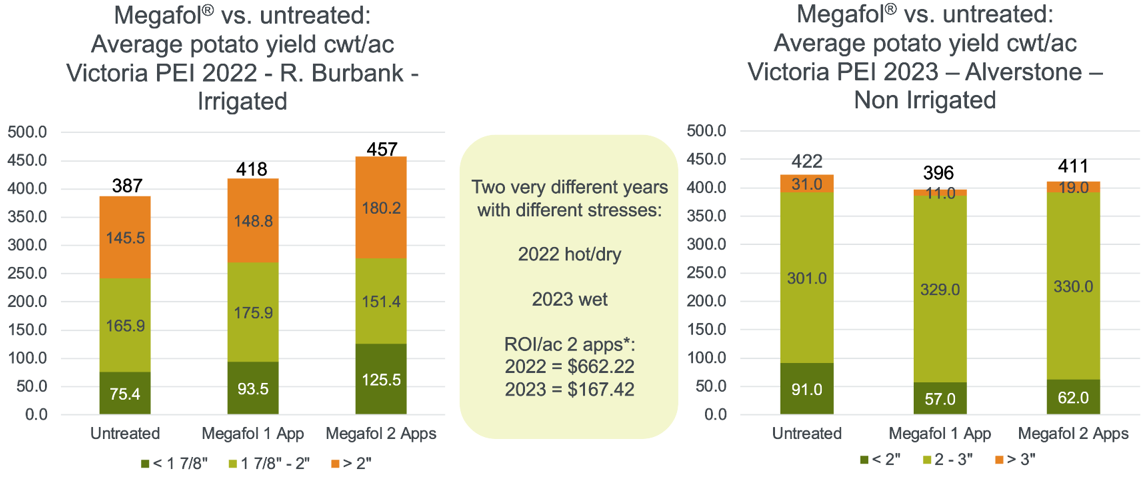
Source: Grower applied trials on PEI 2022, 2023. Yield determined by 3 x 10’ digs in each treated area and grading tubers by size. n = 1 each year. In grower trials, fields were split with Megafol applied once and or twice and untreated areas. 3 x 10’ digs were used to estimate cwt/ac using a conversion factor of 14.5.
*ROI figure assumes 2023 price for potatoes at $17/cwt for tubers >2” or >4 oz plus $3.00/cwt for tubers <2” or < 4oz minus the cost of product (suggested grower price or SGP) and assuming that Megafol was applied in a tank mix application (i.e. no added application cost). Return on investment is based on the foregoing assumptions. Individual results may vary.
Want to learn more? Check out the Megafol technical bulletin.
Challenge #2: Too much rain
Most plant pathogens thrive in wet conditions. So naturally, when a relatively dry spring in Eastern Canada turned into a soggy summer, many fungi and water moulds (Oomycetes) thrived.
In many cases this led to more sprays than usual, raising concerns about maxing out the number of sprays for active ingredients and making fungicide resistance management more difficult. This also provided a good opportunity to consider alternate modes of action across many diseases.
For example, some growers discovered the group 29 fungicide Allegro® 500F, which is now registered on many crops for leaf spot diseases such as apple scab, grape Phomopsis, and Stemphylium in onions.
For water mould diseases like Phytophthora and downy mildews, fruit and vegetable growers looked to the Orondis® brands.

Orondis Gold combines metalaxyl-M (FRAC Group 4) with oxathiapiprolin (FRAC Group 49). Both active ingredients have activity on water moulds, however, oxathiapiprolin has a unique mode of action to target these pathogens. Originally registered on ginseng and berry crops for Phytophthora, a 2023 label expansion now allows for use on onion downy mildew and soil applications to target Phytophthora crown rot (
P.capsici) in peppers.

Orondis Ultra combines oxathiapiprolin with mandipropamid, for exceptional control of late blight. Mandipropamid, a Group 40 fungicide, is an industry standard for managing water moulds, while oxathiapiprolin, a unique Group 49 fungicide, penetrates the leaf surface and moves upward in the plant to effectively protect new growth as well as existing plant material. Typically used in potatoes and tomatoes, Orondis Ultra can provide up to 14-day protection from foliar late blight or Phytophthora blight (
P. capsici).
To add insult to injury, many fungi and Oomycetes overwinter in Canada, so in general, expect greater inoculum loads heading into 2024.
Looking for a refresher on Fungicide Resistance? Check out
this agronomy hub article.
Challenge #3: Rotten berries and grapes
All the rain in the East created ideal conditions for Botrytis cinerea to develop on grapes, blueberries, and strawberries. Plus, there was strawberry anthracnose to worry about, too. Trying to balance crop quality, pre-harvest intervals, resistance management strategies and rotation of chemistry had heads spinning!
Even when preparing for a “normal year” with multiple sprays going on to target tough diseases, and limited tools in the toolbox for controlling them, it doesn’t hurt to give yourself a resistance management refresh before next season. There’s
a short article here with updated FRAC recommendations, or you can get a more in-depth tutorial in
this presentation from Perennia’s March 2023 Berry Primer.
To manage Botrytis, growers often turn to these fungicide products in rotation:

Featuring a unique and powerful Group 29 mode of action, Allegro® 500F fungicide helps you manage a wide range of tough diseases in high-value fruits including, blueberries and grapes.

Inspire Super® fungicide is a combination of two active ingredients (Group 3 + 9) to provide effective, reliable protection against a broad spectrum of diseases across fruit crops, including anthracnose in strawberries, and powdery mildew and Botrytis across berry and grape crops.

Miravis® Prime fungicide is both a contact and systemic product that combines ADEPIDYN® (Group 7) with a reliable performer in fludioxonil (Group 12). Registered on most berries1 and grapes, growers see Miravis Prime as a cornerstone to their Botrytis program.

Count on Switch® 62.5WG (Group 9 + 12) for excellent protection against Botrytis bunch rot in grapes and Botrytis fruit rot in blueberries and strawberries.
Looking ahead to 2024
Looking for more ideas on what to adjust in 2024? Check out the articles on our
agronomy hub or reach out to your local
Syngenta Representative or retail partner for more information.
1 Maximum Residue Limits (MRLs) had been established for
oxathiapiprolin for export markets in the United States and Japan. Please see the Bryant Christie Inc. Global MRL database at
https://www.globalmrl.com/db#query for a complete list of MRLs. Should you need additional information on export market MRLs, please consult with Syngenta to receive the most up-to-date information.
For more information, contact our Customer Interaction Centre at 1-87-SYNGENTA (1-877-964-3682).
Performance evaluations are based on internal trials, field observations and/or public information. Data from multiple locations and years should be consulted whenever possible. Individual results may vary depending on local growing, soil and weather conditions.
Always read and follow label directions. ADEPIDYN
®, Inspire Super
®, Orondis
®, Miravis
®, Switch
® and the Syngenta logo are trademarks of a Syngenta Group Company. Megafol™ is a trademark of VALAGRO S.p.A, a Syngenta Group Company. Allegro
® is a trademark of ISK Biosciences Corporation. © 2024 Syngenta.
