Perfect Time to Plant
April 20, 2020
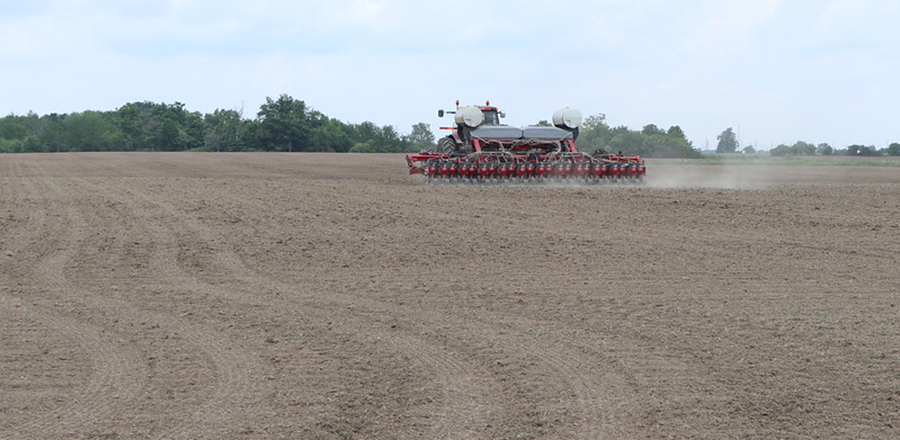
What is the best time to plant soybeans? “There’s no perfect date. There’s only a perfect seedbed,” says Marijke Vanderlaan, Agronomic Service Rep for Syngenta.
“Many growers aim to have their soybeans in as early as possible, but my recommendation is that the best time to plant is when your soil conditions are fit,” she says. A seedbed that has warmed up to an ideal temperature and allows for good seed-to-soil contact will get your soybean crop off to the best possible start.
Wait for warmer temps
The rule book says it’s okay to plant once your soil reaches 10°C, but Vanderlaan warns you also need to look at the weather forecast. Don’t get your equipment rolling if temperatures are going to dip below 10°C or if it is calling for a cold rain within 48 hours after planting. The first drink a soybean seed takes is critical.
“When we have cooler temperatures, it takes longer for that seed to go through its germination process.” Vanderlaan adds. “We want soybeans to get out of the ground as soon as possible. Sometimes trying to push that first two weeks of May window isn’t always the best approach if the crop is going to sit in the ground for a long period of time. Often times, patience pays”. Check out the
NK soybean critical growth stage chart to learn more about early growth stages.
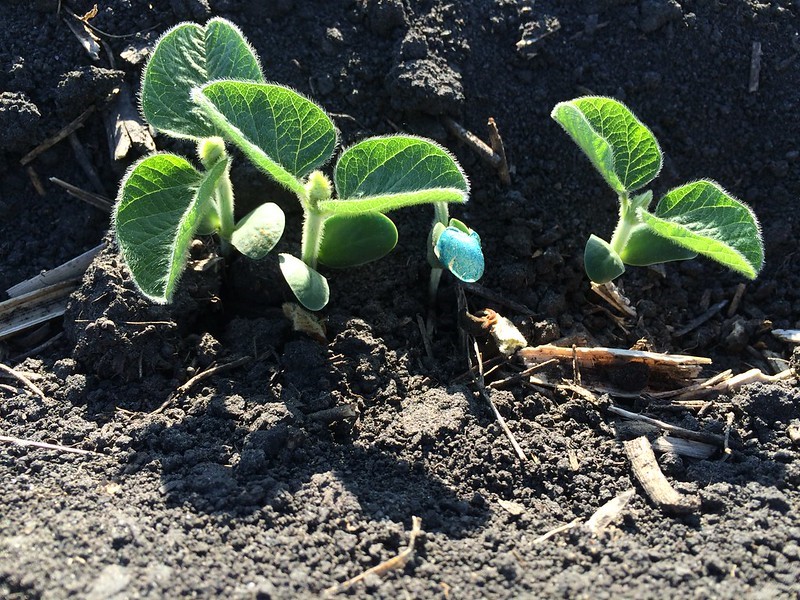
Seeding rate recommendations
Another question Vanderlaan receives as growers get ready to head to the field is related to optimum seeding rates and target populations. Again, there is no one-size-fits-all answer. Rates will vary based on your particular soil type, yield environment and the variety you’re planting.
“I encourage growers to check out the chart we put together (below) that summarizes what they should achieve for final stand counts based on their soil type, the characteristics of their variety and what yield potential they have,” she says.
The chart also includes advice for specific situations. For example, if you’re worried about
white mould, reduce your population by 10% to 20%. If you’re planting late or have poor drainage, increase your population by 10%.
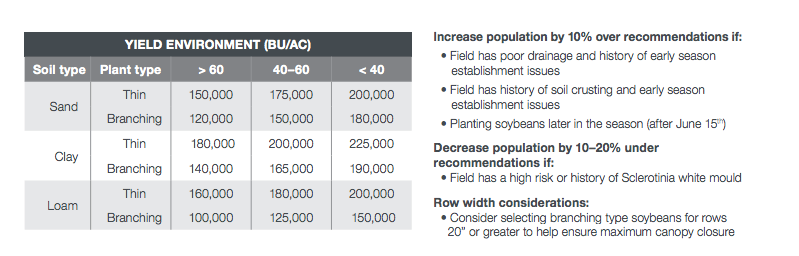
A critical part of the population equation is plant type, such as thin or branching. The
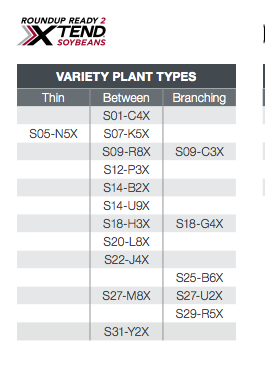
2020 Syngenta Soybean Guide highlights this information for all NK® varieties. To illustrate how seeding rates can vary based on plant architecture, Vanderlaan points to a Roundup Ready 2 Xtend® soybean variety as an example.
“We consider
S18-G4X a branching variety, which is a really great choice when you’re planting in 20 to 30-inch rows. Because it has an ability to branch more than some other varieties, you can consider reducing your seeding rate with this bean. For example, if you’re in a 50-bushel yield environment on loam soil, then you can reduce your population by about 55,000 seeds per acre as compared to a thin style plant that doesn’t branch.”
Make notes for next season
It’s important to note that the chart outlines final stand counts as opposed to seeding rates. For this reason, Vanderlaan says it’s important for growers to understand the gap between their seeding rate and final stand.
“It varies from grower to grower, but typically, we see anywhere from 5% to 20% loss from planting to final stand,” says Vanderlaan. “It’s important to know those numbers for yourself. Take the time this year and actually go out there and do some stand counts and see what you’re getting per acre,” she says. Check out
this Soy Masters resource to help you calculate final stand counts this season.
While past performance information is insightful, Vanderlaan also cautions: “Don’t farm last year’s weather.” This is especially true when it comes to the 2019 growing season in Ontario.“It kept raining and there really wasn’t a window of fit seedbed conditions,” reflects Vanderlaan. “A lot of soybeans got mudded in and thankfully it kept raining and those beans actually did fine, but don’t bank on this to happen in another year.”
Your best bet in 2020 is to strive for perfection – or as close to perfect as your seedbed will offer.
Monsanto Company is a member of Excellence Through Stewardship® (ETS). Monsanto products are commercialized in accordance with ETS Product Launch Stewardship Guidance, and in compliance with Monsanto’s Policy for Commercialization of Biotechnology-Derived Plant Products in Commodity Crops. These products have been approved for import into key export markets with functioning regulatory systems. Any crop or material produced from these products can only be exported to, or used, processed or sold in countries where all necessary regulatory approvals have been granted. It is a violation of national and international law to move material containing biotech traits across boundaries into nations where import is not permitted. Growers should talk to their grain handler or product purchaser to confirm their buying position for these products. Excellence Through Stewardship® is a registered trademark of Excellence Through Stewardship.
ALWAYS READ AND FOLLOW PESTICIDE LABEL DIRECTIONS. Roundup Ready® 2 Technology contains genes that confer tolerance to glyphosate. Roundup Ready 2 Xtend® soybeans contains genes that confer tolerance to glyphosate and dicamba. Glyphosate will kill crops that are not tolerant to glyphosate. Dicamba will kill crops that are not tolerant to dicamba. Contact your local crop protection dealer or call the technical support line at 1-800-667-4944 for recommended Roundup Ready® Xtend Crop System weed control programs. Roundup Ready 2 Xtend®, and Roundup Ready® are registered trademarks of Bayer Group, Monsanto Canada ULC licensee. ©2019 Bayer Group. All rights reserved.
