Stay ahead of grape powdery mildew
December 1, 2025
In short...
- Early-season disease protection is critical, because controlling primary infections will reduce secondary spread.
- Monitor canopy conditions and scout regularly for early powdery spots in shaded, moderate-temperature areas.
- Effective management relies on IPM practices – canopy airflow, variety selection, and timely fungicide applications with resistance rotation.
One of the most common and damaging fungal diseases in Canadian vineyards, powdery mildew threatens yield, fruit quality, and wine flavour.
Grape powdery mildew, caused by the fungus Erysiphe necator (formerly Uncinula necator), is a destructive grapevine disease. While it can affect all grapes, susceptibility to powdery mildew differs among cultivars, including popular wine grapes. Read on below for key considerations and management options.
Powdery mildew prevention tip: Protect grape vines and bunches early through to pea-sized berry stage to prevent most damaging primary infections.
The fungus overwinters as chasmothecia (fruiting bodies) on bark or fallen leaves. In spring, following rainfall, ascospores are released and infect young grapevine shoots and leaves. Primary infection is favoured under optimum temperatures of 20–25 °C. These primary infections are most critical to control, as good control at this stage helps limit the risk of secondary infections throughout the rest of the season.
Secondary infections spread through airborne conidia and can develop quickly when humidity is high, and temperatures are moderate to hot – 15-30°C. At this time, patches of white powdery mildew will develop in 7-10 days. These produce millions of spores that are spread by wind, causing new infections that are not dependent on free moisture like dew.
Powdery mildew spreads rapidly in early summer under moderate temperatures, especially in shaded areas. High temperatures and direct sunlight will inhibit spore production and infection.
Unfortunately, the infection cycle will repeat throughout the season if conditions are favourable, creating season-long challenges if the disease isn’t controlled.
Powdery mildew signs and symptoms to watch for:
Leaves – White powdery spots on the upper surface, may cause leaf curling or yellowing.
Shoots – Brownish lesions or a dusty appearance, eventually turning into dark ink-splotch looking lesions.
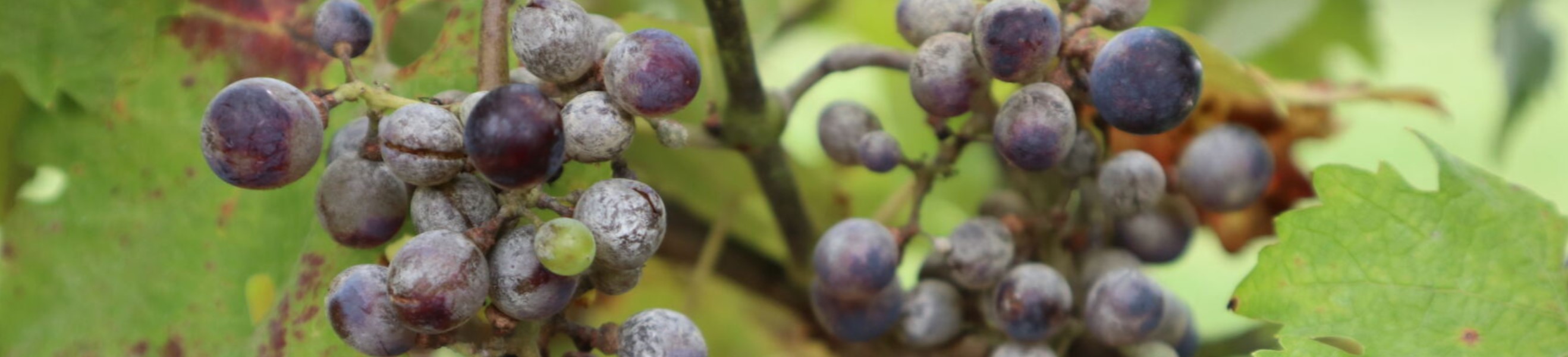
Berries – Gray-white coating early in infection and later, fruit may split or shrivel.
Clusters – Flowers may fail to set if infection occurs early.
Managing powdery mildew
The best way to manage powdery mildew is through an integrated pest management (IPM) program that combines prevention, monitoring, and targeted control strategies.
Key IPM practices should include:
Canopy management – Pruning and thinning shoots will improve airflow and sunlight penetration and reduce humid conditions that promote fungus development.
Variety selection – When possible, choose grape varieties that are less susceptible to mildew.
Leaf removal – Pruning and leaf removal to minimize shading and enhance air movement within the canopy can reduce both the frequency and duration of disease risk periods, particularly under humid conditions.
Fungicides – There are no thresholds for powdery mildew control so chemicals, including sulphur and fungicides should be applied before infection occurs.
Powdery mildew solutions for grapes
Grape growers can confidently manage powdery mildew with Syngenta’s range of effective control options.
| Solution (FRAC Group) | Pests | Timing | Use Rate* | Pre-harvest Interval |
|---|
| Aprovia® Top (3+7) | Powdery mildew | Bud break to post-bloom to berries pea-sized | 643 mL/ha
(260 mL/ac) | 21 days |
| Inspire Super® (3+9) | Foliar anthracnose
Alternaria rot
Powdery mildew
Botrytis bunch rot
Black rot | Bud break to veraison | 836 mL/ha
(338 mL/ac) | 14 days |
| Miravis® Prime (7+12) | Powdery mildew
Botrytis grey mould | Shoot development to veraison | 0.8 L/ha – 1 L/ha
(0.324 L/ac – 0.405 L/ac) | 7 days |
*Use rate for powdery mildew
Managing fungicide resistance
Alternate modes of action and incorporate low risk, multisite fungicides into powdery mildew management programs. Read Tips for slowing down fungicide resistance in fruits for more information about managing fungicide resistance.
Contact your local Syngenta representative or retail partner to discuss how Syngenta tools can support your powdery mildew management program. Their local perspective will help ensure resistance management strategies are best suited to your region and varieties.
Always read and follow label directions. Aprovia®, Inspire Super®, Miravis® and the Syngenta logo are trademarks of a Syngenta Group Company.
