The cost of stress: How abiotic stress steals your yield
April 29, 2026
In summary
- Crops regularly experience abiotic stresses such as heat, drought, cold, wind, hail or nutrient deficiencies.
- Most crops never come close to reaching their genetic potential – not because of weeds or pests, but because abiotic stressors get in the way.
- Biostimulants are changing the game on abiotic stress – and knowing when to use them makes all the difference.
Your crop faces constant pressure from two broad categories of stress that threaten yield and quality:
Biotic stresses – stresses that affect crops that are caused by living organisms, such as bacteria, viruses, insects, nematodes or weeds. These are stresses you can more easily scout for, such as damage from insect pests that feed on plant tissue and drain vital resources, nematodes that damage root systems and disrupt nutrient and water uptake, fungal, bacterial, and viral diseases that disrupt physiological processes, and weeds that aggressively compete with crops for light, water, and nutrients.
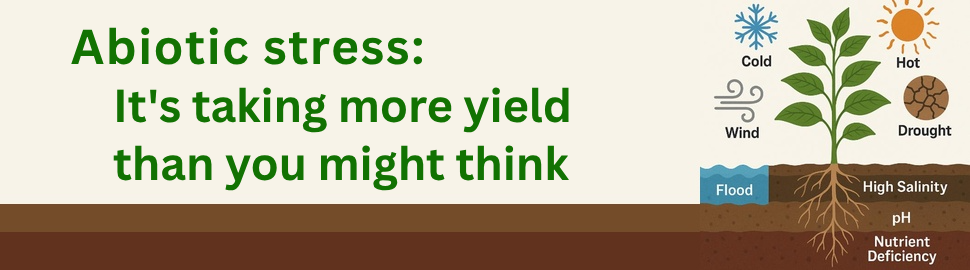
Abiotic stresses – stresses that affect crops that are caused by non-living environmental factors such as temperature, moisture, physical injury or nutrient limitations. These are stresses that are less visible, but have an impact all the same. Abiotic stress can be caused by cold temperatures that impair cellular function and halt development, frost events that break plant cell walls, extreme heat that disrupts photosynthesis and accelerates crop senescence, drought that limits water availability and causes irreversible damage to plant tissue, or events that cause physical damage such as hail.
Abiotic stress does matter
You have a plan for disease and insect pressure – but abiotic stress is quietly responsible for the bigger than expected share of unrealized yield potential.
Research shows that abiotic stress is taking approximately 70% of a crop’s yield potential across major crops.1
But you don't have to sit back and accept that loss. Now there are tools in your toolbox.
Yield impact from abiotic losses for major crops
% of record yield
1Source: Biochemistry and Molecular Biology of Plants, Buchanan, Gruissem, Jones,
American Society of Plant Physiologists, 2000.
Find out how abiotic stress in Western Canada is stealing your wheat yields from Gustavo G. Roelants, Syngenta biologicals marketing lead, in this video.
How to address abiotic stress
An expanding suite of tools is poised and ready to help your crops mitigate abiotic stress – tools that work alongside the conventional crop protection products you’re already familiar with.
Syngenta Biostimulants help to mitigate abiotic stress
Through targeted Canadian field testing, Syngenta is investing in biological solutions to demonstrate their real-world fit within local crop production systems.
There are two stress-mitigating biostimulants in the Syngenta portfolio:

Megafol: the anti-stress and growth activator
Megafol™ is a liquid foliar biostimulant that puts plant growth back on track against the toughest mid-season weather challenges the growing season can serve up.
When applied at or ahead of weather-related stress events, like drought, heat, and hail, Megafol helps your crops spend less time recovering and more time growing.
When to apply:
- Used at the vegetative growth stage
- Applied once at 1 L/ac or a split application of 0.5 L/ac
- Added to your planned herbicide or early fungicide pass
Visit the Megafol product page

YieldON: boost crop productivity
YieldON™ is a liquid foliar biostimulant to ‘switch on’ crop productivity with a unique combination of naturally derived ingredients.
YieldON helps boost the flow of nutrients and sugars throughout the plant, from the leaves to the grain, driving crop productivity.
When to apply:
- Used at the reproductive stage
- Applied once at 0.75 L/ac
- Easily added to your planned late-season fungicide pass
Visit the YieldON product page
Performance evaluations are based on internal trials, field observations and/or public information. Data from multiple locations and years should be consulted whenever possible. Individual results may vary depending on local growing, soil and weather conditions. Always read and follow label directions.
Always read and follow label directions. The Syngenta logo is a trademark of a Syngenta Group Company. Megafol™ and YieldON™ are trademarks of VALAGRO S.p.A., a Syngenta Group Company. © 2026 Syngenta.
