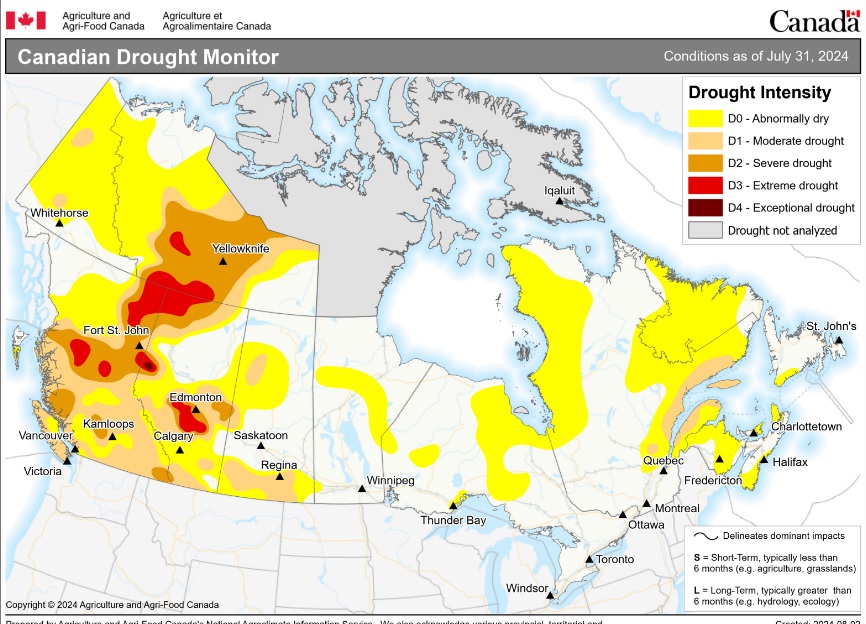
Drought began to creep back into the Prairies in July after being effectively eliminated from agricultural areas in June, as hotter temperatures and uneven rainfall caused soil moisture conditions to deteriorate.
The latest monthly update of the Canadian drought monitor showed 10% of Prairie agricultural lands were being impacted by abnormal dryness or some form of drought as of the end of July. That is a notable deterioration from the end of June, when only 3% of agricultural land was considered abnormally dry, and none was officially in drought.
June marked the first time since March 2020 that drought was completely absent from the Prairie agricultural region.
According to the monitor, precipitation across Western Canada varied sharply during July. Central parts of the Prairies and southern Manitoba received above- to well above normal rainfall, while southern Alberta and much of the northern Prairies remained dry.
Parts of southwestern Manitoba, east-central Saskatchewan and central Alberta received more than 150% of normal July precipitation. In contrast, southwestern Alberta, southwestern Saskatchewan and portions of the northern Prairies received less than 40% of normal.
Temperatures compounded the dryness, with much of the region warmer than average. Southern Alberta and southern Saskatchewan recorded temperatures 3 to 5 C above normal.
Despite the deterioration, the monitor said overall growing season moisture conditions remained generally favourable across most Prairie agricultural areas, where longer-term precipitation totals ranged from 90% to 150% of normal. East-central Alberta has been especially wet, receiving more than 150% of normal precipitation over the past three months.
However, recent rainfall deficits and elevated temperatures caused soil moisture to decline across parts of the southern Prairies. Abnormally dry conditions emerged between Red Deer and Calgary and along several sections of the southern border.
More serious drought conditions developed farther north. Severe drought expanded across northern Alberta, where a new area of extreme drought emerged. Severe drought also expanded substantially across northern Saskatchewan, with a large area north of La Ronge classified as extreme drought.
The Peace region of Alberta and British Columbia remains another area of concern, with growing-season precipitation in some locations below 40% of average.
The combination of limited rainfall and above normal temperatures has contributed to declining soil moisture, poorer crop development, reduced streamflows, shrinking water supplies and increased wildfire activity, particularly across northern areas, the monitor said.