Heavy rain and flooding will take a bite out of Saskatchewan agricultural production this year, according to the latest weekly crop report.
Released Thursday, the report estimated that about 3% of intended Saskatchewan acres went unseeded this spring, while another 3% of the land that did get seeded is unlikely to produce a crop due to flooding. A Statistics Canada acreage report released back in March showed Saskatchewan producers originally intended to plant a total of about 36.4 million acres of crops this year.
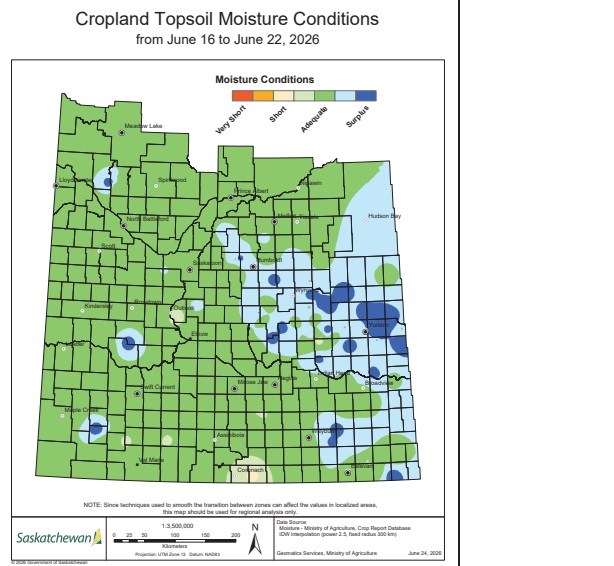
Excess moisture problems are the worst in the province’s east-central region (see topsoil moisture map below), where producers report that up to 8% of total intended acres didn’t get seeded and a further 6% of acres that did get seeded are unlikely to produce a crop due to flooding.
Various causes of crop damage were reported over the past week, the report said, adding that excess moisture remains the ‘primary concern’ and is causing minor to moderate damage in most regions, with a few localized areas reporting severe impacts. In addition, moderate to severe damage from gophers and strong winds has been noted. Hail caused minor to moderate damage in some isolated areas, it added.
Cool and cloudy conditions are also slowing crop development. While most crops are reported to be developing at a normal pace, a notable portion is behind the expected stages of development for this time of year. More than one-third of the spring cereals in the province (34%) were reported as being behind normal development stages for this time of year, along with 45% of the oilseeds and 22% of the pulse crops.
Seeding in the province was estimated at 99% complete as of Monday, up a couple of points from a week earlier.
Over the past week, most regions in the province received significant rainfall. While these rains were welcomed in some areas, excessive precipitation in others has led to saturated fields. Combined with periodic high winds, the rainy conditions have delayed in-crop spraying operations in several regions. The Foam Lake area recorded the highest rainfall this past week at 110 millimetres (mm), followed by Hillsborough with 77 mm. Both Elfros and Lacadena reported 68 mm of rainfall.
Rainfall significantly increased topsoil moisture, with surplus conditions increasing in most areas. Cropland topsoil moisture was rated 20% surplus, 77% adequate and 3% short as of Monday.
Southeast:
Most producers have largely wrapped up seeding within the region and are at 99 per cent completion. Overall, producers are reporting good moisture conditions with the rainfall received in the region this past week. However, the persistence of cool and cloudy conditions and excess moisture in some areas have slowed crop development and in-crop spraying activities. Producers will be hoping for some warm weather over the coming week to continue with in-crop spraying and to help crop development.
The Weyburn area received the highest rainfall amount with 54 millimetres (mm), followed by the Indian Head area with 51 mm and the Francis area 49 mm. Topsoil moisture conditions are mostly rated as adequate in the region with some areas reporting surplus
Southwest;
As seeding wraps up in the region, producers are busy with spraying operations when weather permits. Good moisture conditions are generally reported; however, cool weather conditions continue to slow crop development and in-crop spraying.
The Hillsborough area received the largest amount of rainfall in the region, with 77 millimetres (mm), followed by the Lacadena area with 68 mm and 41 mm in the Craik region. The rainfall received in the area maintained adequate amounts of topsoil moisture in the region
East-Central:
Seeding advanced within the region despite the generally wet conditions encountered, with 96 per cent of the seeding now complete. The region continues to receive significant amounts of rain that is slowing crop development and in-crop spraying activities. Many low-lying areas are also reported to have standing water, causing crop stress.
The Foam Lake area received the highest rainfall amount of 110 millimetres (mm), followed by the Elfros region with 68 mm and the McCraney area with 54 mm of rainfall. Topsoil moisture in the region is mostly rated as adequate with a large amount being surplus.
West-Central:
Seeding is all but done in the region with in-crop spraying ongoing. With much-needed rain received in most areas across the region, producers are now hoping for some warmth in the coming days to speed up crop development which has been slowed from cool weather conditions.
The Eagle Creek area received the highest amount of rainfall in the region with 59 millimetres (mm), followed closely by the Glenside region with 57 mm. The Buffalo area also reported 50 mm of rain.
Northeast:
Seeding is virtually wrapped up in the region with 99 per cent complete. Producers are reporting that crops are in an overall good condition in the region aside from the cool and cloudy conditions that continue to slow crop development. Rain fell throughout most of the region, with the Three Lakes area recording the highest amount at 44 millimetres (mm). This was followed closely by the Duck Lake area with 42 mm and the Bayne area receiving 38 mm.
Northwest:
Seeding is largely wrapped up in the region, with producers focused on in-crop spraying and pest and disease monitoring. Although some much-needed rain was received in many areas within the region, cooler weather conditions have generally slowed crop development. Producers are hoping for favourable weather conditions in the coming days to help speed up crop development and complete spraying activities.
Rainfall varied in the region with the Redberry area receiving the highest amount at 59 millimetres (mm), followed by the Frenchman Butte area with 53 mm and the Eldon region with 42 mm.