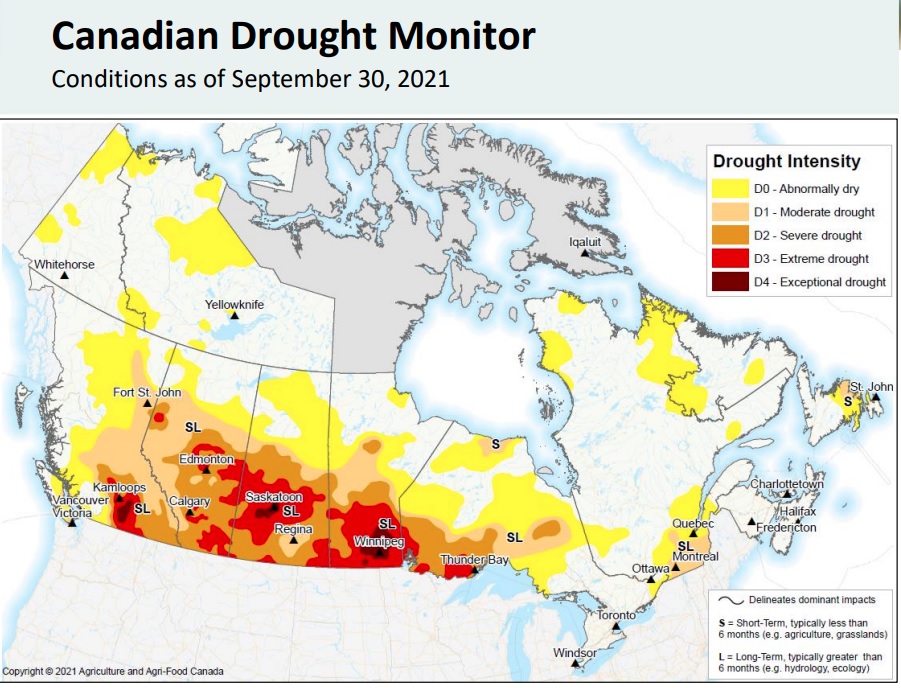
Exceptionally wet conditions through the first half of the month led to a sharp drop in Prairie abnormal dryness and drought in September.
The latest monthly update of the Canadian drought monitor shows just 9% of Prairie agricultural lands were being impacted by abnormal dryness or drought as of the end of September (see map below). That is way down from 35% at the end of August and slightly below 10% at the end of July. In June, just 3% of agricultural lands were considered abnormally dry, and none were officially in drought.
September precipitation varied widely across the Prairies, with southern agricultural regions receiving above- to well-above-normal rainfall while northern areas remained considerably drier, the monitor said.
During the first half of the month, large portions of Alberta, Saskatchewan and Manitoba received more than 200% of normal precipitation. Parts of southern Saskatchewan recorded more than 400% of normal rainfall, while portions of southern Manitoba received up to 350%.
The heavy precipitation caused localized flooding and saturated soils across parts of the southern Prairies. Although conditions turned drier later in September, excessive soil moisture continued to hamper harvest operations and delay fieldwork.
Meanwhile, below-normal precipitation persisted across much of the northern Prairies, particularly from northeastern Alberta through northern Saskatchewan and into northwestern Manitoba.
According to the drought monitor, the substantial rainfall eliminated most areas of abnormal dryness and moderate drought across the southern Prairies.
However, drought conditions persisted northwest of Calgary, reflecting ongoing short- and long-term moisture deficits.
In Saskatchewan, conditions were mixed. Drought improved in parts of the far north but worsened in northeastern areas. Continued dryness also led to an expansion of abnormal dryness and moderate drought across central portions of the province, along with the development of a small area of severe drought.
Temperatures were generally 1–3 degrees C above normal during the first half of September before a brief mid-month cooling trend. Warmer conditions returned later, with temperatures reaching as much as 6 C above normal in parts of northeastern Saskatchewan and northern Manitoba. Some areas recorded daytime highs exceeding 30 C.