Despite ample global grain production and relatively subdued prices, tightening inventories are raising concerns about the potential for future supply disruptions.
A World Bank Group blog post published Thursday warned that declining global stocks-to-use ratios for corn, wheat and rice in 2026-27 could leave agricultural commodity markets increasingly vulnerable to adverse weather, trade restrictions, and geopolitical tensions.
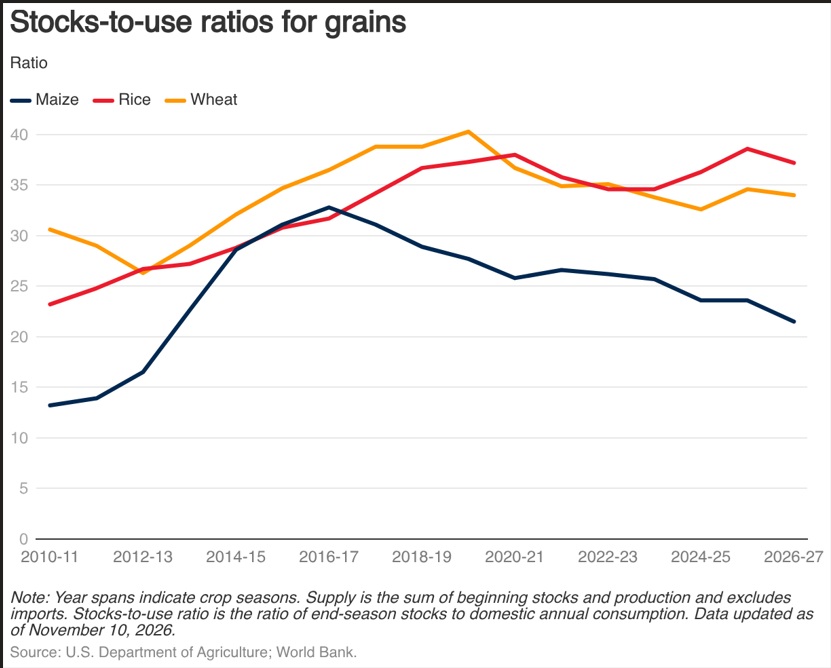
In its October 2026 Commodity Markets Outlook, the World Bank projects the global stocks-to-use ratio for corn will decline to 21.5%, its lowest level since 2012-13 (see graph below). That compares with a ratio of roughly 24% in 2025-26 and a peak of nearly 33% in 2016-17. The stocks-to-use ratio measures ending inventories relative to annual consumption, providing an indication of how much supply is available to cushion unexpected disruptions.
Wheat inventories are also tightening, with the global stocks-to-use ratio forecast to ease to 34% in 2026-27. That is down from a peak of more than 40% in 2019-20. Rice stocks are expected to decline modestly to 37.2%, while the ratio for edible oils is projected to fall to 12.5%, its lowest level since 2009-10.
The World Bank warned that shrinking inventory buffers could amplify price increases if adverse weather reduces production or geopolitical developments disrupt international trade.
The report forecasts global grain prices will rise 14% in 2026 and another 9% in 2027, with risks tilted to the upside amid ongoing Black Sea disruptions, a strong El Nino, and elevated agricultural production costs.