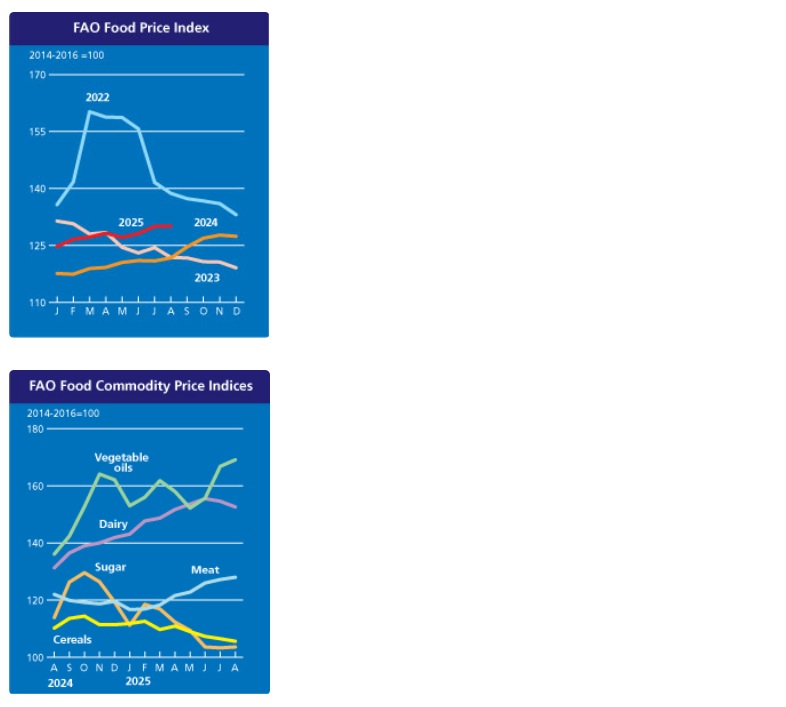
Global food prices rose for a second consecutive month in August, reaching their highest level since late 2022, as adverse weather, geopolitical tensions and trade disruptions increased concerns about supplies of major agricultural commodities.
The Food and Agriculture Organization of the United Nations said Friday that its Food Price Index averaged 133.3 points in August, up 1.9% from a revised July reading and 2.5% above a year earlier. The index had risen 0.6% in July after declining 0.3% in June.
Despite reaching its highest level in about four years, the index remained roughly 17% below the all-time high of 160.2 points reached in March 2022 following the Russian invasion of Ukraine
Cereal prices were among the main drivers of the August increase. The FAO cereal price index averaged 116.3 points, up 2.2% from July and reaching its highest level since May 2024. Prices increased across all major grains amid strong demand, weather concerns and continued uncertainty surrounding Black Sea exports.
World wheat prices rose 2.6% from July and stood 15% above a year earlier. Gains were supported by persistent disruptions to Black Sea export logistics, reduced production prospects in parts of Europe following hot and dry weather, and a weaker U.S. dollar that improved the competitiveness of dollar-denominated exports, the FAO said.
International corn prices increased 2.5%, reflecting mounting concerns about U.S. Corn Belt yields and deteriorating European Union production prospects due to prolonged heat and dryness. Strong ethanol and feed demand, disruptions to Ukrainian exports and concerns over input supplies following the closure of the Strait of Hormuz provided additional support.
Sorghum prices rose 3.9% and barley gained 2.6%, while the FAO All Rice Price Index increased 0.5% on sustained Asian and African demand and expectations for tighter supplies.
Vegetable oil prices also remained elevated. The FAO vegetable oil price index averaged 196.9 points, up 0.6% from July for a third consecutive monthly increase and its highest level since June 2022.
Palm oil prices advanced on strong global import demand and concerns that El Nino could affect Southeast Asian production. South American soyoil prices remained firm amid strong export demand, although U.S. soyoil declined moderately as uncertainty over biofuel policy clouded domestic feedstock demand. Sunflower and rapeseed oil prices edged lower on subdued import demand and expectations for ample 2026-27 supplies.
Meanwhile, the FAO sugar price index surged 11.9% amid concerns about European beet yields, Asian production, lower Brazilian output, and India’s move to allow duty-free raw sugar imports.
The dairy price index increased 2.3% as hot, dry European weather tightened milk supplies, while the meat price index rose 1%, led by higher poultry, pork and sheep meat prices.