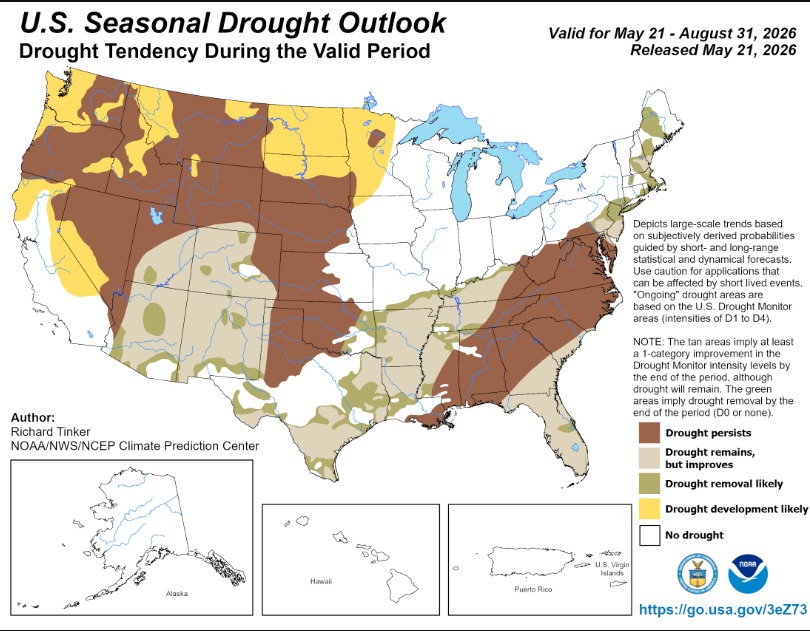
Drought is expected to largely spare the U.S. Midwest this summer, even as much of the rest of the country remains plagued by dryness.
Released late last week, the latest seasonal drought outlook from the U.S. Climate Prediction Center (shown below) projects no drought development in the heart of the Midwest through the end of August. The outlook is generally favourable for the core U.S. Corn Belt, where much of the country’s corn and soybean production is concentrated.
However, forecasters warned that drought could still develop across portions of the northwestern Corn Belt. The official outlook favours subnormal precipitation over parts of Iowa, Minnesota, and western Wisconsin, and drought is expected to persist where it exists, expanding northeastward to cover a large part of Minnesota and a small portion of Iowa by the end of August.
On the other hand, the past few weeks to months have been wetter than normal across most of the Great Lakes, so it is unlikely that even somewhat below normal summer precipitation would push the region into drought, the outlook said.
Elsewhere in the Midwest, recent rainfall has improved conditions in southern Missouri and parts of Kentucky, where forecasters expect drought improvement or removal following heavy late-May precipitation.
Outside the Midwest, the drought outlook becomes considerably more concerning for major wheat-growing regions across the Plains. Forecasters project drought persistence and expansion for parts of Kansas, through much of Nebraska and into the Dakotas, areas critical for Hard Red Winter wheat and spring wheat production.
Much of the western United States is also forecast to remain dry through the summer, although some drought relief is possible in parts of the Southwest and Four Corners region if seasonal monsoon activity strengthens later in the season, the seasonal drought outlook said.
As of May 19, more than 62% of the continental U.S. was being impacted by some form of drought, including about 45% in severe to exceptional drought.