Crops across Saskatchewan are suffering as ongoing rainfall and excess moisture continue to take a toll on fields, according to the latest provincial crop report on Thursday.
Rainfall continued across many areas of the province during the week ending Monday, with some regions also reporting minor to severe hail. Producers are now seeing more visible effects from the excessive moisture received over the past two weeks, including yellowing crops, drowned-out areas and slower crop development.
The heaviest rainfall was reported in the Calder area, which received 112 mm. Glaslyn followed with 103 mm, while Radville and Churchbridge received 83 mm and 80 mm, respectively. Regular rainfall events have also delayed in-crop spraying and haying, leaving producers waiting for warmer, drier weather.
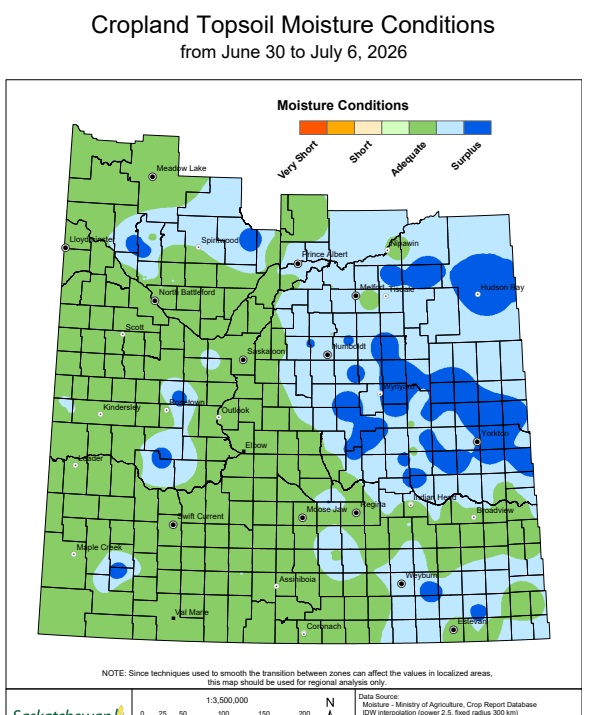
Although many areas received more rain, the share of cropland rated with surplus topsoil moisture slipped slightly from the previous week. Even so, moisture levels remain high across the province, with cropland topsoil moisture rated 30% surplus, 69% adequate and 1% short.
As shown on the map below, the wettest conditions are concentrated through parts of eastern and east-central Saskatchewan, with notable surplus areas around Yorkton, Hudson Bay, Weyburn, Esterhazy, Wynyard and areas east and northeast of Regina. Additional pockets of surplus moisture appear through the northwest and west-central regions, including areas near Lloydminster, North Battleford, Unity and Kindersley. Much of the western and southwestern grain belt remains in the adequate category, with only small scattered pockets showing short moisture.
Crop development remains highly variable. Winter cereals are most advanced, with 56% heading and 34% at the dough stage. Spring cereals are spread across several stages, with 34% at flag leaf and 14% heading. Canola and mustard are also variable, with 37% bolting, 27% flowering and 1% podded. Pulse crops are further along, with 43% flowering and 3% podded.
Wet conditions continue to slow haying. Provincially, only 4% of the first hay cut has been completed, with 2% baled or silaged. Hay quality is rated 13% excellent, 66% good, 8% fair and 13% poor. Pastures remain strong, rated 38% excellent, 55% good and 7% fair.
Flooding remains the main source of crop damage, while hail, gophers, cabbage seedpod weevil and wind have also caused localized damage.
The full crop report can be seen here:
https://publications.saskatchewan.ca/api/v1/products/128638/formats/155324/download