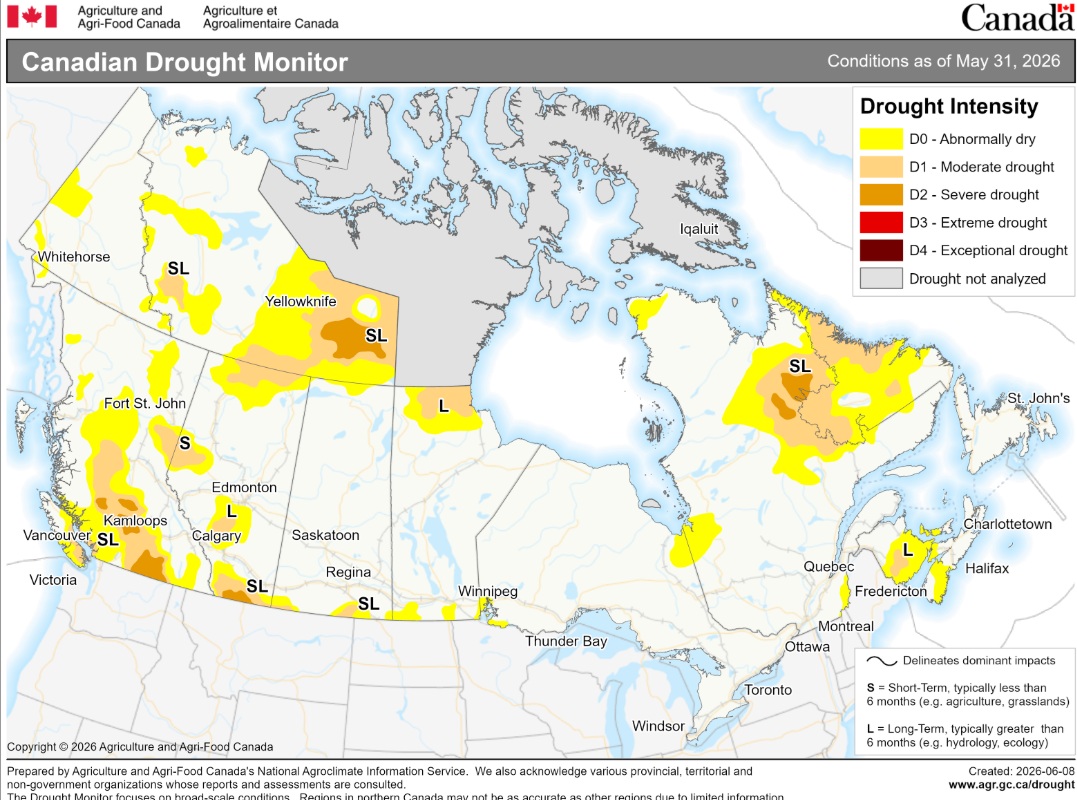
Abnormal dryness and drought across Western Canada were little changed in May compared to a month earlier.
The latest monthly update of the Canadian drought monitor shows 19% of Prairie agricultural lands were being impacted by abnormally dry or drought conditions as of the end of May. That is 2 points higher than the end of April but slightly below 21% at the end of March and sharply below 47% in February.
Much of the Prairie Region received below to well below normal precipitation in May, with the Peace Region, south-central Saskatchewan, and southern Manitoba recording less than 25% of normal.
On the last day of the month, however, a large storm system in Alberta produced 40 to 80 mm of precipitation alone. In east-central Alberta up to 300% of normal monthly precipitation fell in the one day. Significant rainfall was also recorded in western regions of Saskatchewan but at lower levels than in eastern Alberta, the monitor said.
Temperatures were generally below normal across most of the Prairies in May, especially in the northern half of the region, where departures from normal exceeded 5 degrees C in some areas. Early in the month, a brief warm spell triggered rapid melting of an unusually heavy winter snowpack, leading to severe localized flooding in Saskatchewan.
That warm period was followed by a prolonged stretch of cold weather. A mid-month storm brought snow and exceptionally strong winds, before conditions shifted sharply late in the month to extreme heat and much drier weather. Temperatures reached 34 to 37 C during the fourth week of May, breaking records across the region.
Despite the wide swings in weather, drought conditions across the Prairies did not change significantly during the month, the monitor said. Cooler temperatures helped limit evaporation and slowed vegetative growth, reducing soil moisture losses, and easing the impact of short-term precipitation deficits.
Abnormally dry and moderate drought conditions persisted through west-central Alberta due to ongoing short- and long-term moisture deficits. In southern Alberta and southwestern Saskatchewan, abnormally dry to severe drought conditions were little changed from April.
However, some improvement was noted in southeastern Alberta and southwestern Saskatchewan, particularly in areas previously affected by abnormally dry and moderate drought conditions. The most notable deterioration occurred in the Peace Region of northwestern Alberta, where abnormally dry and moderate drought conditions expanded during the month.